2 September 2014
The mother of all myths: Our theory is true.
20 September 2016Here is an excerpt of the final myth in my new book 'Bust those Management Myths'.
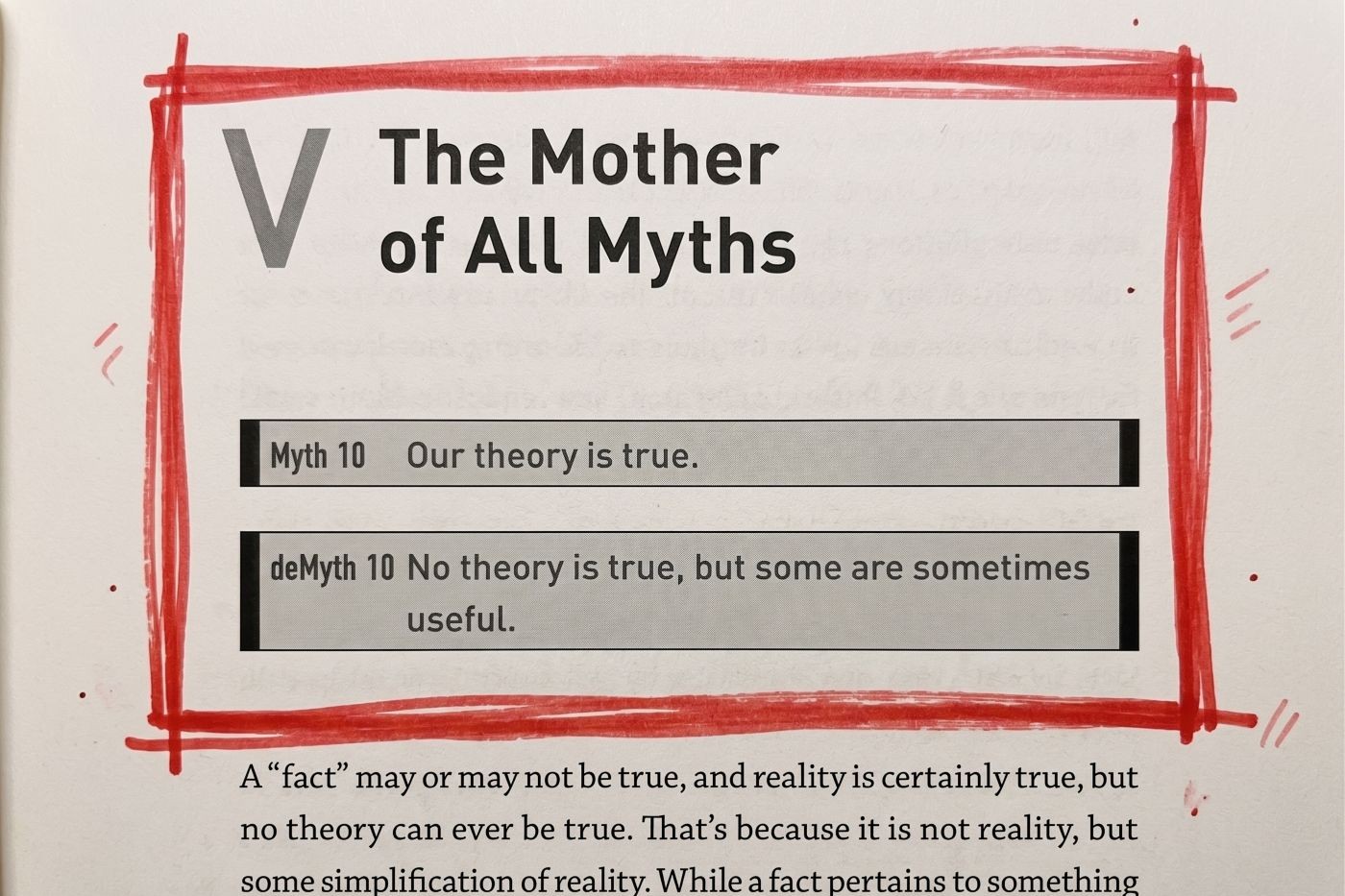
A “fact” may or may not be true, and reality is certainly true, but no theory can ever be true. That’s because it is not reality, but some simplification of reality. Fact: this book presents ten myths. Theory: (one of them) managers plan, organize, coordinate, and control. The problem is that reality is vast, whereas theory is focused —ultimately, just a bunch of words and symbols. No theory can ever be big enough to capture all of the reality in question.
Here is a prominent example. In 1492, Christopher Columbus discovered truth: that the Earth is round, not flat. Did he? Is it? When I look out my window, I see a lake, which looks flat, surrounded by hills, which look bumpy. Of course, seen from space, the Earth does look round, but that’s because we can’t discern its tiny little bumps, like Mount Everest. In actual fact, the Earth is not quite round: it bulges at the equator, making it slightly spheroid rather than perfectly spherical. This gives us yet another limited theory about the reality that is the Earth.
Were the Earth flat, Columbus would have sailed over the edge, and we would never have heard from him again. Lucky for him, it was rather round, at least on the seas that he sailed. And lucky for me, our lake is rather flat because when the ice forms, I love to skate on it—and skating uphill can be tricky.
So, what are we to make of this? That I am going off theorizing about theory? No, this is important because—here comes the 10th deMyth—while we must never take any theory to be true, we can often take some theories to be useful, but only under particular circumstances.
The round earth theory worked fine for Columbus, sailing on the sea, just as the flat earth theory works fine for me, skating on the lake. (Imagine if I had to correct for the curvature of the lake every time I went skating.) You see, we make constructive use of all kinds of flawed theories. Donald Hebb, McGill’s renowned psychologist, explained this rather nicely: “A good theory is one that holds together long enough to get you to a better theory.”
Theory as Dogma Many proper scientists don’t get this. They battle with each other over their respective one best theory. Einstein’s theory of relativity debunked Newton’s theory of mechanics. So what? We still make great use of the latter.
Such learned people turn their theory into a dogma that suppresses thinking. Let’s take the example of a theory from economics that once brought us great wealth but is now destroying our societies: essentially, that greed is good, markets are sufficient, and governments are suspect. As one view of human nature, this makes some sense. As the view of human nature, it is nonsense. Where is community? Where is benevolence?
Theory as Practical Some people who call themselves “practical” poo-poo theory as impractical. But we can no more get along without theory than can we get along without files on the Internet, because theories, likewise, help us to organize incoming information. As John Maynard Keynes quipped, “Practical men, who believe themselves to be quite exempt from any intellectual influences, are usually the slaves of some defunct economist.”
It would be nice if we could carry reality around in our heads, and use it to make decisions and manage. Unfortunately, no head is that big. So, we carry around theories instead, consciously or not, alongside our own cumulation of experiences. But, for the sake of thoughtfulness, we must carry around various theories, not any one best theory, to be able to choose the most useful under the circumstances. As F. Scott Fitzgerald put it, “[T]he test of a first-rate intelligence is the ability to hold two opposed ideas in the mind at the same time, and still retain the ability to function.” If only managers could keep it to two!
Our Myths and deMyths as Theories The myths of this book are theories in their own right, or else they build on some theory. For example, business as the one best way is built on the claim that governments are suspect. So, don’t get mystified by any claims about truth in this book, and that includes the deMyths as well as the myths. Recognize that all can sometimes be useful and sometimes not. Strategic planning, for example, may be fine when an organization needs to program a strategy that is working well, just as communityship should be suspect when it encourages groupthink. We have to keep our minds open for the next good theory that comes along, bearing in mind that it, too, could eventually turn out to be mythical.
© Henry Mintzberg, 2026.